
For comprehensive and diagnostic individualized testing from preschool thru high school to college and early career transitions, EIC has you covered!

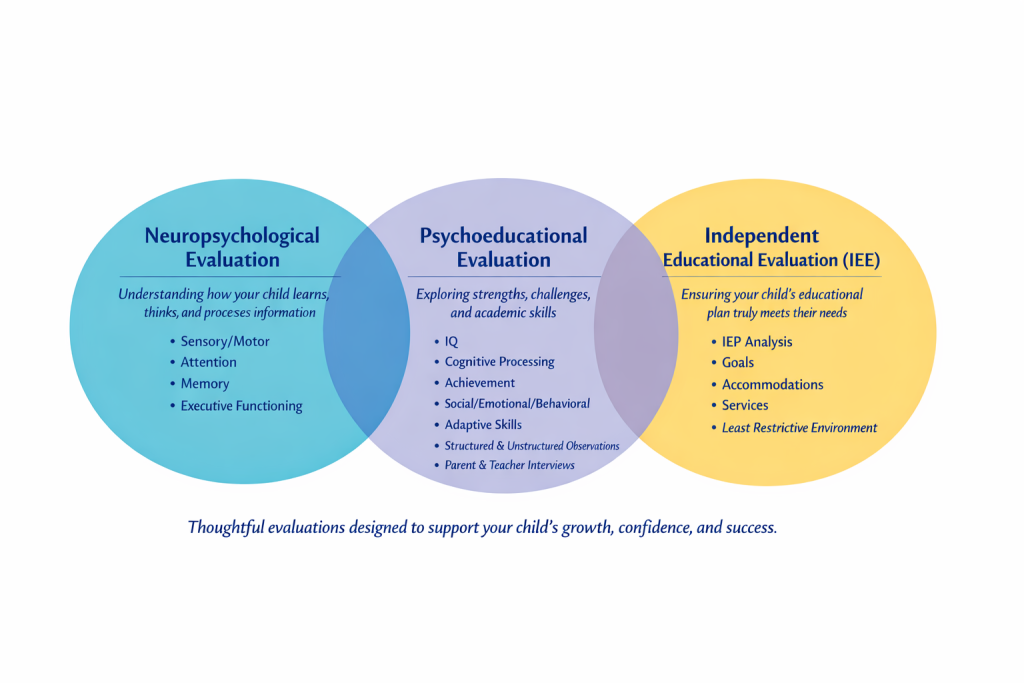
Evaluation, Assessment & IEE Services
All evaluations and assessments are conducted using a combination of in-person (direct testing with the client) and virtual (parent interview, client interview, results sharing, etc.) methods.
EIC offer competitive pricing, Superbills for out-of-network insurance reimbursement, and creative payment plans to help families more easily access educational services for their child. Please call for a free consultation!
As a part of all evaluations, EIC also offers families guidance on next steps in supporting the child in school, at home and in the community and refer the client to other providers accordingly.
Manual therapy
Consectetur adipiscing.
Acupuncture
Consectetur adipiscing.
Lymphatic drainage
Consectetur adipiscing.
Pilates
Consectetur adipiscing.
Taping
Consectetur adipiscing.
Posture training
Consectetur adipiscing.
What is it? A psychoeducational evaluation is a comprehensive assessment of a student’s cognitive, academic, and socio-emotional functioning. These evaluations are commonly used to determine if a student is eligible to receive special education services. Additionally, they inform the delivery and type of related services your child may receive through an IEP. Psychoeducational evaluations consist of both standardized and non-standardized assessment tools and methods including direct testing, observations and interviews.

Who is an ideal candidate for a psychoeducational evaluation?
- An individual who is not meeting major developmental milestones
- An individual struggling to learn pre-academic or academic skills
- An individual who is not making adequate progress toward additional support or intervention
- An individual who is struggling to pay attention; control their behavior and emotions, stay organized
- An individual who is struggling to pay attention; control their behavior and emotions, stay organized
- An individual who is experiencing symptoms of anxiety, depression, or other mental health challenges

Psychoeducational Evaluations Include
- Assessment of intelligence, cognitive processing skills, academic achievement, executive functioning, social/emotional/behavioral and adaptive skills
- Observations in structured and unstructured settings at the child’s school of attendance and review of present levels of academic performance
- Consultation/Interviews (parent, teacher, and private providers as applicable)
- Attendance at 1, 2-hour IEP or other meeting (virtual or in-person)

Psychoeducational Evaluation Process

Psychoeducational Evaluation
What is it? A psychoeducational evaluation is a comprehensive assessment of a student’s cognitive, academic, and socio-emotional functioning. These evaluations are commonly used to determine if a student is eligible to receive special education services. Additionally, they inform the delivery and type of related services your child may receive through an IEP. Psychoeducational evaluations consist of both standardized and non-standardized assessment tools and methods including direct testing, observations and interviews.
Psychoeducational Evaluation Process
Who is an ideal candidate for a psychoeducational evaluation?
- An individual who is not meeting major developmental milestones
- An individual struggling to learn pre-academic or academic skills
- An individual who is not making adequate progress toward additional support or intervention
- An individual who is struggling to pay attention; control their behavior and emotions, stay organized
- An individual who is struggling to pay attention; control their behavior and emotions, stay organized
- An individual who is experiencing symptoms of anxiety, depression, or other mental health challenges
Psychoeducational Evaluations Include
- Assessment of intelligence, cognitive processing skills, academic achievement, executive functioning, social/emotional/behavioral and adaptive skills
- Observations in structured and unstructured settings at the child’s school of attendance and review of present levels of academic performance
- Consultation/Interviews (parent, teacher, and private providers as applicable)
- Attendance at 1, 2-hour IEP or other meeting (virtual or in-person)
What is it? Neuropsychological evaluations analyze how different areas of the brain influence cognitive processes like memory, attention, language, and problem-solving. Specifically, they seek to identify a child’s unique pattern of cognitive processing strengths and weaknesses to better understand not only which diagnoses with which they present, but how the child learns. By identifying cognitive strengths, specific intervention strategies that capitalize upon them can be utilized to more effectively help a child make more meaningful growth toward their educational and developmental goals.

Who is an ideal candidate for a neuropsychological evaluation?
- A child who was prenatally exposed to toxins, experienced a traumatic birth or experienced a traumatic brain injury
- A child with a complex medical or neurodevelopmental syndrome
- A child with a low-incidence disability who is not making adequate progress toward IEP goals despite receiving a substantial amount of services, either in school and/or through private therapies
- A child with significant reading, mathematics or written expression needs and for whom a specific subtype of dyslexia, dyscalculia or dysgraphia has not yet been identified
- A child who otherwise has strong academic skills but is still struggling to perform on grade level in school

Neuropsychological Evaluations include
- Assessment of intelligence, cognitive processing skills, academic achievement, social/emotional, behavioral and adaptive skills
- Direct assessment of executive functioning, attention, immediate and delayed memory and learning, and additional cognitive processing skills as applicable
- Observations in structured and unstructured school settings
- Consultation/Interviews (parent, teacher, and private providers as applicable)
- Attendance at 1, 2-hour IEP or other meeting (virtual or in-person)

Neuropsychological Evaluation Process
Neuropsychological Evaluation
What is it? Neuropsychological evaluations analyze how different areas of the brain influence cognitive processes like memory, attention, language, and problem-solving. Specifically, they seek to identify a child’s unique pattern of cognitive processing strengths and weaknesses to better understand not only which diagnoses with which they present, but how the child learns. By identifying cognitive strengths, specific intervention strategies that capitalize upon them can be utilized to more effectively help a child make more meaningful growth toward their educational and developmental goals.
Neuropsychological Evaluation Process
Who is an ideal candidate for a neuropsychological evaluation?
- A child who was prenatally exposed to toxins, experienced a traumatic birth or experienced a traumatic brain injury
- A child with a complex medical or neurodevelopmental syndrome
- A child with a low-incidence disability who is not making adequate progress toward IEP goals despite receiving a substantial amount of services, either in school and/or through private therapies
- A child with significant reading, mathematics or written expression needs and for whom a specific subtype of dyslexia, dyscalculia or dysgraphia has not yet been identified
- A child who otherwise has strong academic skills but is still struggling to perform on grade level in school
Neuropsychological Evaluations include
- Assessment of intelligence, cognitive processing skills, academic achievement, social/emotional, behavioral and adaptive skills
- Direct assessment of executive functioning, attention, immediate and delayed memory and learning, and additional cognitive processing skills as applicable
- Observations in structured and unstructured school settings
- Consultation/Interviews (parent, teacher, and private providers as applicable)
- Attendance at 1, 2-hour IEP or other meeting (virtual or in-person)
What is it? An Independent Educational Evaluation (IEE) is an evaluation that may be requested by a family if they disagree with the results of or determine that the District’s evaluation of their student was not comprehensive. This evaluation may be approved or denied by the District. If approved, the District is liable to pay the entire cost of the IEE, at no expense to the family.

How do I know if I should request an IEE for my child?
- If you do not agree with the results of a child’s most recent school-based evaluation
- If you feel parts of the evaluation were omitted or not sufficiently assessed (i.e., speech and language, sensory, Autism, etc.) and therefore was not comprehensive
- If you feel the child’s IEP, including the goals, accommodations, services, and location of services, does not adequately reflect or address the totality of your child’s educational needs
What does an IEE entail?
Testing consists of all areas of suspected disability outlined on the Assessment Plan the District offers the family. Once signed, an IEE may begin.
Where is testing conducted?
Testing is conducted either in the child’s school setting or per contract and/or other agreement between the district, parent and the evaluator.

Types of IEEs Offered
- Assessment of intelligence, cognitive processing skills, academic achievement, executive functioning, social/emotional/behavioral and adaptive skills
- Observations in structured and unstructured settings at the child’s school of attendance and review of present levels of academic performance.
- Consultation/Interviews (parent, teacher, and private providers as applicable)
- Attendance at 1, 2-hour IEP meeting (virtual or in-person)
- Assessment of intelligence, cognitive processing skills, academic achievement, executive functioning, social/emotional/behavioral and adaptive skills
- Direct assessment of executive functioning, attention, immediate and delayed memory and learning, and additional cognitive processing skills as applicable.
- Observations in structured and unstructured school settings
Consultation/Interviews (parent, teacher, and private providers as applicable) - Attendance at 1, 2-hour IEP meeting (virtual or in-person)
- Mental status exam & assessment of risk factors
- Assessment of social / emotional / behavioral functioning using a variety of direct and indirect measures (teacher, parent, student)
- Consultation/Interviews (parent, teacher, and private providers as applicable)
- Structured and unstructured school observations
- Attendance at 1, 2-hour IEP meeting (virtual or in-person)
- Direct and indirect assessment of antecedents, behaviors and consequences maintaining maladaptive behaviors
- Structured and unstructured school observations
- Consultation/Interviews (parent, teacher, and private providers as applicable)
- Attendance at 1, 2-hour IEP meeting (virtual or in-person)
- Assessment of independent functioning levels and need for assistance across home and school settings
- Structured and unstructured school observations of entire school day
- Consultation/Interviews (parent, teacher, and private providers as applicable)
- Attendance at 1, 2-hour IEP meeting (virtual or in-person)
- Direct and indirect assessment of academic skills (reading, mathematics, writing, listening comprehension, oral expression, etc.)
- Structured and unstructured school observations
- Consultation/Interviews (parent, teacher, and private providers as applicable)
- Attendance at 1, 2-hour IEP meeting (virtual or in-person)

What is the Process for Requesting an IEE from my Child’s School District?
The exact process may vary across school districts.
- The parent requests an IEE from their child’s school district
- The District responds to the parent with a Prior Written Notice within 15 days of receiving the letter requesting an IEE stating their agreement or disagreement with the request
- If an IEE is granted, the family notifies the school they wish for a professional at Education Innovators Consulting to conduct the IEE
- If the District approves, the District will draft a contract for the IEE examiner to sign. If the District disapproves of the evaluator, the parent may request another provider conduct the IEE
- Once the signed contract for an IEE is received by the District, the contract will be presented to the District’s Board of Education for approval:
- If approved, the IEE Evaluation Process outlined below may begin and occur within the timeframe agreed upon by the family and the District
IEE Evaluation Process
School Districts in which EIC has conducted IEEs
- Los Angeles Unified School District
- Torrance Unified School District
- Long Beach Unified School District
- Ventura Unified School District
- Atascadero Unified School District
- Orange Unified School District
- Several Districts in the Metro Dayton, OH Area
Independent Educational Evaluations (IEE)
What is it? An Independent Educational Evaluation (IEE) is an evaluation that may be requested by a family if they disagree with the results of or determine that the District’s evaluation of their student was not comprehensive. This evaluation may be approved or denied by the District. If approved, the District is liable to pay the entire cost of the IEE, at no expense to the family.
What is the Process for Requesting an IEE from my Child’s School District?
The exact process may vary across school districts.
- The parent requests an IEE from their child’s school district
- The District responds to the parent with a Prior Written Notice within 15 days of receiving the letter requesting an IEE stating their agreement or disagreement with the request
- If an IEE is granted, the family notifies the school they wish for a professional at Education Innovators Consulting to conduct the IEE
- If the District approves, the District will draft a contract for the IEE examiner to sign. If the District disapproves of the evaluator, the parent may request another provider conduct the IEE
- Once the signed contract for an IEE is received by the District, the contract will be presented to the District’s Board of Education for approval:
- If approved, the IEE Evaluation Process outlined below may begin and occur within the timeframe agreed upon by the family and the District
IEE Evaluation Process
School Districts in which EIC has conducted IEEs
- Los Angeles Unified School District
- Torrance Unified School District
- Long Beach Unified School District
- Ventura Unified School District
- Atascadero Unified School District
- Orange Unified School District
- Several Districts in the Metro Dayton, OH Area
How do I know if I should request an IEE for my child?
- If you do not agree with the results of a child’s most recent school-based evaluation
- If you feel parts of the evaluation were omitted or not sufficiently assessed (i.e., speech and language, sensory, Autism, etc.) and therefore was not comprehensive
- If you feel the child’s IEP, including the goals, accommodations, services, and location of services, does not adequately reflect or address the totality of your child’s educational needs
What does an IEE entail?
Where is testing conducted?
Types of IEEs Offered
- Assessment of intelligence, cognitive processing skills, academic achievement, executive functioning, social/emotional/behavioral and adaptive skills
- Observations in structured and unstructured settings at the child’s school of attendance and review of present levels of academic performance.
- Consultation/Interviews (parent, teacher, and private providers as applicable)
- Attendance at 1, 2-hour IEP meeting (virtual or in-person)
- Assessment of intelligence, cognitive processing skills, academic achievement, executive functioning, social/emotional/behavioral and adaptive skills
- Direct assessment of executive functioning, attention, immediate and delayed memory and learning, and additional cognitive processing skills as applicable.
- Observations in structured and unstructured school settings
Consultation/Interviews (parent, teacher, and private providers as applicable) - Attendance at 1, 2-hour IEP meeting (virtual or in-person)
- Mental status exam & assessment of risk factors
- Assessment of social / emotional / behavioral functioning using a variety of direct and indirect measures (teacher, parent, student)
- Consultation/Interviews (parent, teacher, and private providers as applicable)
- Structured and unstructured school observations
- Attendance at 1, 2-hour IEP meeting (virtual or in-person)
- Direct and indirect assessment of antecedents, behaviors and consequences maintaining maladaptive behaviors
- Structured and unstructured school observations
- Consultation/Interviews (parent, teacher, and private providers as applicable)
- Attendance at 1, 2-hour IEP meeting (virtual or in-person)
- Assessment of independent functioning levels and need for assistance across home and school settings
- Structured and unstructured school observations of entire school day
- Consultation/Interviews (parent, teacher, and private providers as applicable)
- Attendance at 1, 2-hour IEP meeting (virtual or in-person)
- Direct and indirect assessment of academic skills (reading, mathematics, writing, listening comprehension, oral expression, etc.)
- Structured and unstructured school observations
- Consultation/Interviews (parent, teacher, and private providers as applicable)
- Attendance at 1, 2-hour IEP meeting (virtual or in-person)

Unveil the ultimate rest experience
Sed ut perspiciatis unde omnis iste natus ut perspic iatis unde omnis iste perspiciatis ut perspiciatis unde omnis iste natus.